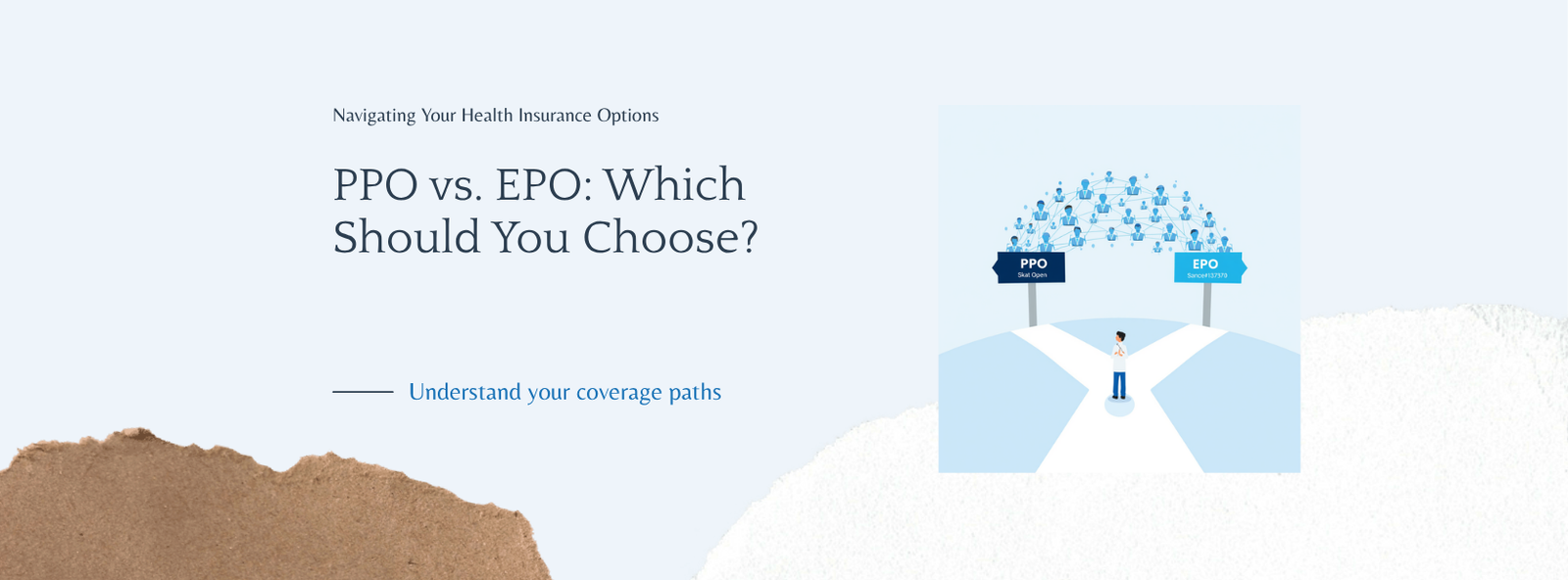
The difference comes down to one question: what happens when you see a doctor outside the plan's network? A PPO (Preferred Provider Organization) still covers out-of-network care — you pay a higher share of the cost, but you are covered. An EPO (Exclusive Provider Organization) covers in-network care only (except emergencies), requires no referrals, and generally costs less each month. Neither one requires you to choose a primary care doctor or get referrals to see specialists — that is what separates both of them from an HMO.
For most Californians the practical decision is simple: choose a PPO if keeping specific doctors and specialists matters most, choose an EPO if you want referral-free specialist access at a lower premium and your doctors are in the network, and consider an HMO if the lowest premium matters most and you don't mind referrals.
| PPO | EPO | HMO | |
|---|---|---|---|
| See specialists without a referral | Yes | Yes | No — referral required |
| Out-of-network coverage | Yes, at a higher cost-share | Emergencies only | Emergencies only |
| Primary care doctor required | No | No | Yes |
| Relative monthly premium | Highest | Middle | Lowest |
| Best for | Keeping specific doctors; frequent travelers | Referral-free access at a lower price | Budget-first shoppers comfortable in one system |
Emergency care is covered at in-network cost-sharing on every ACA-compliant plan, on any plan type, anywhere in the U.S.
On California's individual market, most on-exchange plans today are HMOs and EPOs. Individual-market PPO availability varies by county and by carrier, and it changes from year to year. This is exactly where working with a licensed advisor matters: we check which plan types actually operate in your county and verify your doctors and hospitals against each plan's current network before you enroll — not after.
For those who need broader PPO access than the individual market offers, exclusive private, employer-level (ERISA) group PPO options with nationwide networks may be available year-round for those who qualify — the same coverage structure large employers use. Availability is subject to eligibility; call us to see if you qualify.
For the same person, in the same county, at the same metal tier, a PPO generally carries the highest premium, an EPO typically prices below it, and an HMO below that. Two cost details worth knowing: out-of-network care on a PPO usually runs through a separate, higher deductible with higher coinsurance, and out-of-network providers can bill you the difference above the plan's allowed amount. Premiums vary by age, region, and the financial assistance you may qualify for — comparing plans with a licensed advisor is a no-cost service, and premiums are identical with or without one.
Is an EPO better than a PPO?
Neither is "better" — an EPO trades out-of-network coverage for a lower premium. If your doctors are in-network and you rarely travel for care, an EPO may deliver the same practical access for less. If you want the safety net of out-of-network coverage, that is what a PPO is for.
Do EPO plans cover emergencies away from home?
Yes. Emergency care is covered at in-network cost-sharing on all ACA-compliant plans, anywhere in the U.S.
Do I need a referral to see a specialist on a PPO or EPO?
No. Both plan types let you book specialists directly — that is the main difference from an HMO.
Can self-employed Californians get a PPO?
Often, yes — through the individual market where PPOs are offered in their county, or through employer-level (ERISA) group options for those who qualify. Availability varies, and we verify what is actually offered where you live.
Why does the same doctor cost more on one plan than another?
Cost depends on whether the doctor is in that specific plan's network and on the plan's deductible and copay structure — not on the doctor. That is why we check networks before you enroll.
Are PPO and EPO plans more expensive than Affordable Care (e.g. Covered California) plans?
They can be the very same plans — PPOs and EPOs are sold both on and off the exchange. What changes your price most is whether you qualify for financial assistance, which we can check for you at no cost.
By Brandon D. Sears, RHU® — Licensed Health & Life Insurance Advisor · CA License #0G03485 · Updated July 25, 2026